Tuesday, 8 January 2019

मोटर वाहन अधियम (संशोधन) २०१७ पारित क्यों नहीं हो रहा है ?


१० अप्रैल २०१७ को लोकसभा ने मोटर वाहन अधियम (संशोधन) २०१७  को पारित कर दिया था। यह बिल को लोकसभा में अगस्त २१६ में प्रस्तुत किया गया था ताकि होने वाली सड़क घटनाए और मौत को कम किया जा सके। इस बिल को लाने का मुख्य कारण सड़क व्यव्य्स्था जो दुर्घटनाएँ रोक नहीं पा रही है उसे रोक सके। एक और मुख्य कारण यह भी था की लोग नियमो का पालन नहीं कर रहे और नियमो और जुर्माने को और सख्त करने की आवश्यकता है।मोटर वाहन अधिनियम (संशोधन) २०१७ को प्रधानमंत्री नरेंद्र मोदी के कैबिनेट से अगस्त २०१७ में स्वीकृत्ति मिल चुकी है।भारत में हर मिनट एक बड़ी और चिंताजनक दुर्घटना होती है और हर घंटे १६ लोगो की मौत हो जाती है। करीबन २० बच्चे  १४ साल से काम उम्र के उनकी मौत हो जाती है हर दिन सड़क दुर्घटनाओं के कारण। सड़क दुर्घटना से होने वाली मौत  की २०१५-२०१६ में % से बढ़ोतरी हुई है।
  • वाहनों का पंजीकरण और चालक को लाइसेंस बनवाने के लिए अब आधार कार्ड अनिवार्य है। 
  • इन संशोधन को केंद्रीय सड़क परिवहन और राजमार्ग मंत्री के द्वारा लोकसभा में प्रस्तुत किया गया।
  • इन संशोधनों में सबसे बड़ा एक संशोधन 'हिट एंड रन' के मामले में किया गया है।  जहाँ 'हिट एंड रन' के मामलो में मुआवज़ा २५००० रुपये था, उसे अब बढ़ा कर लाख रुपये  कर दिया गया है।
  • मोटर वाहन अधियम १९९८ में थर्ड पार्टी को बीमा की कोई सीमा नहीं दी गयी थी लेकिन इस संशोधन के तहत मौत के मामले में १० लाख रूपये और गंभीर चोट के मामले में ५ लाख रूपये से ज़्यादा नहीं होगा।
  • इस बिल के आने के बाद इलेक्ट्रॉनिक मॉनिटरिंग जैसे टेक्नोलॉजी का भी प्रयोग किया जायेगा ताकि जो लोग नियमो को तोड़ रहे है और अपराध कर रहे है उन्हें सजा दी जाए।
यह बिल अभी तक पारित नहीं किया गया है उसकी मुख्य वजह यह है की विपक्ष की पार्टी का कहना है कि आधार कार्ड को ज़रूरी नहीं कर सकते क्यूंकि आधार में बहुत कमियाँ है जिसकी वजह से हम उसे अनिवार्य नहीं कर सकते। नए प्रावधान के आने से पब्लिक वाहन सेक्टर प्राइवेट सेक्टर के लिए खुल जाएगा और कर विभाग पर भी प्राइवेट सेक्टर का पूरा नियंत्रण होगा। अगर यात्रा के सभी वाहनों का नियंत्रण प्राइवेट सेक्टर से होगा तो सरकार यात्रा के शुक्लो को कम नहीं कर पाएगी जो लोगो के लिए बहुत हानीकारक साबित हो सकता है।

Friday, 4 January 2019

This is how the Motor Vehicles Amendment Bill 2017 is going to help India financially

In a nation where every four minute a person dies because of road accidents, our nation faces a loss worth billions every year. India spends almost 3% of its GDP annually on these road-accidents. That’s Rs 55,000 crore ($8.2 billion) per annum. Every year, over 1,47,000 people die because of Over-speeding, drunk driving, not using necessary safety gears and due to many other factors. Most of the financial support received from UN is spent on managing freeways, highways and road construction while most of the value from the amount received is spent on the aftermath of the accidents like accident management and repairing works. India is only behind Japan ($63,000 million) in terms of money spent on road accidents, in the study covering 19 countries of the Asia-Pacific region, while in terms of GDP loss it comes behind Iran which is at 6 percent ($30,697 million).

With a dramatic reduction in the number of road-accidents all over India, this amount can be reduced drastically. India looks forward to reduce road crash fatalities by 50% by 2022. The Motor Vehicle Amendment Bill 2017 is a big and an ambitious step forward to achieve the stated goal. The MVA Bill 2017 promotes safer driving by enforcing stricter laws, higher penalties and making the licensing system centralized.

Some major changes which are proposed in the Bill are as follows:
  • Mandatory Aadhar for centralization of the whole system. 
  • For deaths in hit-and-run cases, the government will provide a compensation of Rs 2 lakh or more to the victim's family. Currently, the amount is just Rs 25,000. 
  • People fears helping an accident victim from getting into additional trouble. MV Act 2017 promises to keep your identity secret in this case. Good Samaritans gets extra secrecy.
  • The Motor Vehicles Amendment Bill ensures National Transportation Policy’ to establish a framework for road transportation planning discussing with state governments. Better roads for better security.
  • Under the Motor Vehicles Act, 1988, there is no limit for a third-party car or two-wheeler insurance. The Bill, however, amends to cap a maximum third-party legal liability to Rs. 10 lakh for death and Rs. 5 lakh for serious injuries.
  • Compulsory automatic fitness training for vehicles reduces the chances of unsafe vehicles getting permit to run on the roads. Safer vehicles to make safer roads.
  • Electronic Monitoring will ensure better recognition of law violators and stricter actions against offenders.
The slow pace and delay on road constructions due to road crashes, different private sector’s works on road construction and repair works are the main reasons of a huge amount of money being spent on road-safety each year, but not quite much difference has been observed in the stats of road accidents in the past decade at all.
With a centralized database, it will be easier to fight against fake or duplicate driving license and punish law breakers and criminals in a better way. MVA Bill aims to reduce road traffic accidents and casualties 50% by the next few years. If this becomes successful, it will be a huge to boost the country’s GDP, thus, reducing the huge amount of finance spent on this field too. With a better infrastructure, more money spent on the improvement of the current road network will make the country’s transport system better than ever while helping the economy too.
Let’s change the road safety scenario for a better and a safer India!

#MeriZiddMVA2017 #IDemandaSaferIndia #HumseFarakPdtaHai

Thursday, 3 January 2019

MOTOR VEHICLE ACT OLD V/S NEW


Vehicles as a means of transportation are being used in our country even before the Britishers invaded India. A systematic approach towards roads and vehicles came after India became a British colony. Hence, there was a need for some rules, regulations, and laws related to the code of conduct on roads. So the first Indian Motor Vehicle Act was introduced in 1914, for easy and accurate administration.

The "Indian Motor Vehicles Act, 1914" was central legislation passed and applicable in British India. It had 18 sections and gave local governments the responsibility of registering and licensing vehicles and motorists and enforcing regulations. It was replaced by the Motor Vehicles Act, 1939, which came into force in 1940.

With the rise in technology and progress of the country, the laws also needed modifications which led to the latest Motor Vehicle Act was proposed in 1988.

In 2017, the amended act of MVs was passed by Lok Sabha but is currently on hold at Rajyasabha.

96% believe that passage of the Bill would help meet the UN mandate to reduce road accidents up to 50% by 2020, according to a survey conducted by Consumer Voice, an organization involved in policy-making and complaints redressal.

97% people believe that the Bill should be supported by all the parties since it is important to bring down fatalities due to road accidents, currently one of the highest in the world at 1.46 lakh annually.

The bill has added many new sections and amendments in some already existing sections.


The various differences between the new and the older MV act are as follows:

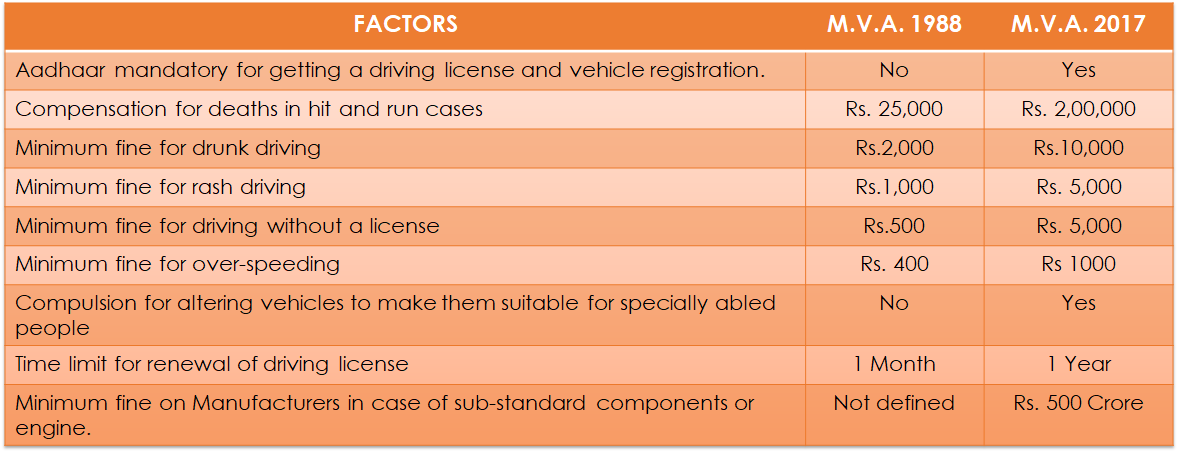
1) The act wants to make Aadhaar Card mandatory for getting a driving license and vehicle registration.

2) For deaths in hit-and-run cases, the current compensation is as low as just Rs.25,000. This act proposes an increased compensation of Rs 2 lacs or more to the victim's family.

3) In traffic violations by juveniles, the guardians or owner of the vehicle would be held accountable unless they prove the offense was committed without their knowledge or they tried to prevent it. The registration of the motor vehicle in question will be canceled. The juvenile will also be tried under the Juvenile Justice Act.

4) The bill has provision for the protection of Good Samaritans. Those who come forward to help accident victims will be protected from civil or criminal liability. It will be optional for them to disclose their identity to the police or medical personnel.

5) The minimum fine for drunk driving has been increased from Rs 2,000 to Rs 10,000.

6) The fine for rash driving has been increased from Rs 1,000 to Rs 5,000.

7) Driving without a license will attract a minimum fine of Rs 5,000 as against Rs 500 at present.

8) The fine for over-speeding will go up from Rs 400 to Rs 1,000-2,000.

9) Not wearing a seatbelt would attract a fine of Rs 1,000 as against Rs 100 at present.

10) Talking on a mobile phone while driving will attract a fine of Rs 5,000, up from Rs 1,000.

11) A Motor Vehicle Accident Fund will provide compulsory insurance cover to all road users in India for certain types of accidents.

12) It will be mandatory to alter vehicles to make them suitable for specially-abled people.

13) Contractors, consultants, and civic agencies will be accountable for faulty design, construction or poor maintenance of roads leading to accidents.

14) A time limit of six months has been specified for an application of compensation to the Claims Tribunal with regard to road accidents.

15) The Bill removes the cap on liability for third-party insurance. The 2016 Bill had capped the maximum liability at Rs 10 lakh in case of death and Rs 5 lakh in case of grievous injury.

17) Once made, people usually tend to forget to renew their license. And just a month is a very short time for renewal, so the limit for renewal of a driving license is increased from one month to one year before and after the expiry date.

18) Compromise in the quality of components required in vehicles may lead to some disastrous incidents plus environment degradation. The act has a provision in which the government can recall vehicles whose components or engine do not meet the required standards. Manufacturers can be fined up to Rs 500 crore in case of sub-standard components or engine.


Here’s an in short comparison between the M.V.A 1988 and the M.V. Amendment bill 2017


As it can be easily observed that there's a huge difference between the old MV act and the amendments proposed. Lok Sabha has passed the proposed amendments, but Rajyasabha has kept it on hold. The changes which will come along with the passage of this bill might be the key element towards the reduction in the number of deaths due to road accidents.


Wednesday, 2 January 2019

WHY THE MOTOR VEHICLE AMENDMENT 2017 IS STILL NOT PASSING


On 10th April 2017, the Lok Sabha passed the Motor Vehicles Amendment Bill, 2017. The amendment’s draft was put forward in the lower house of the Parliament in August 2016 to impose an updated law for better results in the field of road safety. The amendments were targeted towards bringing changes in the current condition of unsafe roads to encourage safer driving practices among Indian Motor Vehicle Drivers by imposing stricter laws and higher penalties. The amendment, approved by PM Narendra Modi-led Cabinet on Aug 2016 which aims to reduce the number of road accidents and fatalities resulting from the same. If we talk about the current condition of Indian road safety, one serious road accident in the country occurs every minute and 16 dies on Indian roads every hour. If we talk about fatal road accidents, there is a sharp rise from 131,726 fatal accidents in 2015 to 136,071 fatal accidents in 2016. A total of 134,796 fatal accidents were reported in 2017.  According to government statistics, every year 5 lac road accidents are reported. There are 223 Sections out of which the Bill has tried to amend 68 sections. 
Some major changes in the law are:
  • Mandatory Aadhaar for centralization of the whole system.
  • For deaths in hit-and-run cases, the government will provide a compensation of Rs 2 lacs or more to the victim's family. Currently, the amount is just Rs 25,000.
  • People fear to help an accident victim from getting into additional trouble. MV Act 2016 promises to keep your identity secret in this case. Good Samaritans get extra secrecy.
  • The Motor Vehicle Act ensures National Transportation Policy to establish a framework for road transportation planning discussing with state governments. Better roads for better security.
  • Under the Motor Vehicles Act, 1988, there is no limit for a third-party car or two-wheeler insurance. The Bill, however, amends to cap a maximum third-party legal liability to Rs. 10 lakh for death and Rs. 5 lakh for serious injuries.
  • Compulsory automatic fitness training for vehicles reduces the chances of unsafe vehicles getting a permit to run on the roads. Safer vehicles to make safer roads.
  • Electronic Monitoring will ensure better recognition of law violators and stricter actions against offenders.
In the parliament, the opposition questions about making the Aadhar mandatory and questions the centralization after different faults of the Aadhar has already been noticed by everyone. But beyond this factor, the MV Amendment 2017 demands compulsion of Aadhar. The Motor Vehicle Amendment Bill (MVA Bill) has provisions which open up the public transport sector for the private companies and also control and regulate permits and taxation. Public Transportation System at present is under the direct control of the State Government, State Transport Undertakings (STUs). These STUs offer traveling facilities at low rates as compared to private buses. If the private sector interferes in this sector, it may create more difficulty for the public and will be a threat to the job security of the employees working under State Transport Undertakings.
Because the jobs of employees working under STUs are under threat because of this bill, the opposition strongly protested against this bill in the parliament. These are the main restrictions the MV Act 2017 is facing.
While all this resistances are working against the MV Bill, it actually is working towards less corruption in the field of transportation and road safety. The centralization of driving licenses will help fight duplicate driving licenses or even more than one driving licenses for an individual for different states. Also, centralized monitoring, e-registration, and the national database will help to fight corruption on a massive level.
The MV Act 2017 looks forward to reducing the road accidents all over India by 50% by 2022 by stricter laws than ever before and centralization of driver’s registration, giving more power to centre, private sectors. With the cooperation of the massive youth of the nation, this law looks forward to a bright future in the field of road safety.

Tuesday, 1 January 2019

MOTOR VEHICLE AMENDMENT ACT 2017: ALL YOU NEED TO KNOW


The Motor Vehicle Act, the MV Act 1988 of the Parliament of India regulates all aspects of road transport vehicles. But it is being practised with its own insufficiencies and a lot of aspects that needs to be changed in the current time. This act is currently handling all legal aspects of using any motor vehicle on Indian roads, from driving license to penalties. But certain aspects of the act needs to be updated to be relevant in the current time.
Motor Vehicle (Amendment) Bill 2017, approved by PM Narendra Modi-led Cabinet on Aug, 2017 which aims to reduce the number of road accidents and fatalities resulting from them. If we talk about the current condition of Indian road safety, one serious road accident in the country occurs every minute and 16 die on Indian roads every hour. 20 children under the age of 14 die every day due to road crashes in in the country. Road crash fatalities have increased by 3% from 2015 to 2016. If we talk about fatal road accidents, there is a sharp rise from 131,726 fatal accidents in 2015 to 136,071 fatal accidents in 2016. A total of 134,796 fatal accidents were reported in 2017. According to government statistics, every year 5 lakh road accidents are reported.
In the present Motor Vehicle Act, there are 223 Sections out of which the Bill has tried to amend 68 sections. The making of new provisions in the MV Act 2017 is to simplify the third party insurance claims and settlement process. The new provision ensures higher penalties and higher compensation for hit and run cases. The Motor Vehicle Bill proposes insertion of 28 new sections. Introductions of these new amendments are to improve road safety and citizens ease. They also focus on making the roads and the current road-infrastructure better and better connectivity all around the nation. It focuses on strengthening rural transport automation and computerization, enabling online services too.
The following are key highlights of the bill:
  • Higher Penalties imposition on traffic rules violations
  • Cashless Treatment for Road Accident Victims
  • Increased Compensation for The Family of The Deceased
  • Inclusion of Good Samaritan Guidelines
  • National Transportation Policy
  • Compulsory Insurance
  • Recognition of Offences Committed by Juveniles
  • Automated Fitness Training for Vehicles
  • National Registry for Licenses and Registrations
  • Electronic Monitoring

While, the new Motor Vehicle Amendment bill of 2017 faces different difficulties in the way of approval. The Motor Vehicle Amendment Bill (MV Bill) has provisions which opens up the public transport sector for the private companies and also control and regulate permits and taxation. It also aims to giving more power to the Central government.
The Bill was deliberated upon in Rajya Sabha witnessed resistance of the Bill from many political parties of the opposition and the Bill is yet to be passed by Parliament. The Bill Proposes introduction of section 66A to create a National Transportation Policy in consultation with the states for which a consultative mechanism would be put in place.
With the sudden burst of number of vehicles on the roads with our increasing GDP and increasing affordability of automobiles, there are more accidents happening on the roads of India than ever before. The next generation will have to face a massive amount of traffic on the roads and a massive number of near-death experiences on roads too. So this Amendment in Motor Vehicle Act might be the much needed step to make our roads safer than ever.
Every year India spends almost 3% of its GDP in road accidents which is a huge value. With safer and better roads situations can be improved. Also with amendments like stricter laws ,higher penalties on violation and the increment in compensation, the government might be able to curb the number of deaths due to road accidents, hence the goal of a safer India might be achieved.
Here are some key highlights of the increased penalties as proposed by the bill:
  • For deaths in hit-and-run cases, the government will provide a compensation of Rs 2 lakh or more to the victim's family. Currently, the amount is just Rs 25,000.
  • The minimum fine for drunk driving has been increased from Rs 2,000 to Rs 10,000.
  • The fine for rash driving has been increased from Rs 1,000 to Rs 5,000.
  • Driving without a licence will attract a minimum fine of Rs 5,000 as against Rs 500 at present.
  • The fine for over-speeding will go up from Rs 400 to Rs 1,000-2,000.
  • Not wearing seatbelt would attract a fine of Rs 1,000 as against Rs 100 at present.
  • Talking on a mobile phone while driving will attract a fine of Rs 5,000, up from Rs 1,000.

Making the laws stricter, to spend on the betterment of the current infrastructure of the roads can bring a dramatic change in the current statistics of India’s road safety.


Wednesday, 26 December 2018

If Not Now, Then When? The Time to Act is Now!

Hi,
Glad that you took out time to read this piece amidst the festivities! Hope you had a great Christmas and are planning for a great New Year- 2019!
Am sure, your resolution list would be already brimming with items that reflect your aspirations! If you allow, I would like to add one item to that list. Ok, before we dwell into what that is , let me ask you a question. Have you ever seen a Jumbo Jet?
 
 Better, ever travelled in one? A Boeing 747 or an Airbus 380 is called as a Jumbo Jet because of their large size. A Jumbo Jet, generally used for inter-continental travel carries not only approximately 400+ people across destinations but carries hopes, aspirations of more than 400+ families for thousands of miles on their next destinations, aims in life!
In the current scenario in India, 400 people lose their lives every day on Indian roads (Does this ring a bell now?). Same like jumbo jets, Indian roads and vehicles help us travel from one location to the other. One destination to next. One aim to the other. But of all those Indians who make these journeys everyday, some 400 of them get lost somewhere in between and put their families on a road of difficulty, pain and suffering. A jumbo jet is losing its way and disappearing in thin air every day!
Of these few die because of their own fault while the rest die because of the fault of others! 20 children under the age of 14 die every day in India, just because of the fault of someone else. The state of affair seems more and more appalling as we dig deeper.
Can you, now, realize the magnitude of the problem? What If I told you, by the time you read this bit, somewhere in India a person would have met with a road-accident and by the time you are done reading this article, one of 4 people would have lost their life. 
How the Problem Has Aggravated
 India signed the Brasilia Declaration in 2010 and agreed to become a party to the nations who agreed to reduce the number of road-crash fatalities by 50% till 2020 however the figure has only been constantly increasing till recently. As we enter into 2019, we look into one of the worst failures of not only the Indian Govt but all of us ever! From approx 75,000+ people in 2010 we lost more than 1.45 lakh people in 2017! The figures have doubled and so has the length and breadth of the problem!
India added more cars to the roads in the last 10 years than most of the EU countries combined but forgot to inherit the driving sense and the required infrastructure to support the burden! As the vehicles increased – the fatalities increased exponentially but no action has been taken!
From problems like potholes, to weaker laws, to weak driving habits, no strict enforcement, lack of strict laws to poor post-accident emergency care, if you start to reason out why we are facing the possibilities of having road-crashes as one of the top-5 reasons for human deaths by 2030 or currently as the leading cause of death for people between 5-29 years of age – the answer lies within.
Did you put your seatbelt today while driving? Did you stop at the red light? Did you ask your friend to be a bit un-cool today and wear that helmet? Did you take a cab after your xmas party and did not drink and drive?
As India faces one of the largest man-made disaster today, its time all of us pledge that we would come together and make sure no more lives are lost to this!

Current Most Important Issue in RS Space: MV Amendment Act 2017
While, we sip our chai in the hot weather, oblivious to the issue of “road-safety”, there has been a long tussle going on in the Indian Parliament related to the Motor Vehicle (Amendment) Bill, 2017.
[ The Motor Vehicle Act, the MV Act 1988 of the Parliament of India regulates all aspects of road transport vehicles but it is being practiced with its own insufficiencies and a lot of aspects that needs to be changed in the current time. This act is currently handling all legal aspects of using any motor vehicle on Indian roads, from driving license to penalties. But certain aspects of the act need to be updated to be relevant in the current time and to make our roads safe]
Motor Vehicle (Amendment) Bill 2017, approved by PM Shri Narendra Modi-led Cabinet on Aug, 2017 which aims to reduce the number of road accidents and fatalities resulting from them. In the present Motor Vehicle Act, there are 223 Sections out of which the Bill has tried to amend 68 sections. The making of new provisions in the MV Amendment Act 2017 is to simplify the third party insurance claims and settlement process. The new provision ensures higher penalties and higher compensation for hit and run cases. The Motor Vehicle Bill proposes insertion of 28 new sections. Introductions of these new amendments are to improve road safety and citizens’ ease. They also focus on making the roads and the current road-infrastructure better and better connectivity all around the nation. It focuses on strengthening rural transport automation and computerization, enabling online services too.
The Bill though has already been passed in Lok Sabha but is being deliberated upon in Rajya Sabha which witnessed opposition from many political parties of the opposition and hence is yet to be approved. The parties have brought to fore many issues including but not limited to more power concentrated in hands of the Central Govt than the state govt.
Some important revisions being proposed in the MV (Amendment) Act 2017:
  • For deaths in hit-and-run cases, the government will provide a compensation of Rs 2 lakh or more to the victim’s family. Currently, the amount is just Rs 25,000. 
  • The minimum fine for drunk driving has been increased from Rs 2,000 to Rs 10,000. 
  • The fine for rash driving has been increased from Rs 1,000 to Rs 5,000. 
  • Driving without a licence will attract a minimum fine of Rs 5,000 as against Rs 500 at present. 
  • The fine for over-speeding will go up from Rs 400 to Rs 1,000-2,000. 
  • Not wearing seatbelt would attract a fine of Rs 1,000 as against Rs 100 at present. 
  • Talking on a mobile phone while driving will attract a fine of Rs 5,000, up from Rs 1,000. 
At this moment, we all need to support the MV (Amendment) Act, 2017 in the present form as though it might have a few downsides – which can be improved subsequently, but if the act is not passed in the current Winter Session of the Parliament, the bill would lapse and then would depend on the next elected government to present in the parliament and implement the same. Hence, it would be again next 2-3 years before we can have the better act implemented to ensure Safer Roads.
Currently, WHO with Indian Road Safety Campaign, Solve are running a campaign that can motivate the MPs in Rajya Sabha to show their support towards the act and help its passage! To do your bit for the same, please sign the petition here: iitd.info/mva2017 

Why We All Need to Come Together
Road-safety like other major public health issues is a multi-sectoral issue and needs each and every-one to come together so that we can completely eradicate this problem. From healthcare to law, from engineering to design, from policy making to enforcement, from 80 year old to a school going kid- everyone needs to do their bit to make Indian Roads Safer!
If we need to make our roads safe, each one of us needs to follow rules! There are instances where a drunk driver ramps into a car being driven properly carrying a family – killing everyone. There are instances where young kids are crushed by high-speed vehicles near schools. All of us are equally important to make safe roads and safer ecosystem. The parents needs to follow traffic rules to set better examples infront of their kids, the PWD dept and authorities need to develop better roads and immediate remediation of potholes). Additionally, the post-accident emergency care needs to ramp up, the roads need to have better design, the enforcement needs to be better and stricter and there needs to be wide-spread awareness about the issue.
Like passage of the MV (Amendment) Act, which can only be passed if everyone in the Indian Parliament is united and comes together irrespective of their political affiliations, at each and every step of this journey, we need to come together and act for the cause.
 Can I Do Something to Change the Scenario?
Yes, absolutely! Road-safety like any other social problem is an issue where humans are the problems and solution themselves. Let us not let even one death go unnoticed. In the current scenario, one death is considered insignificant and too many deaths become a statistic. We together need to come together and change this perception. A death, a human death should not be insignificant and we all need to make sure no further lives are lost on Indian roads.

What can a simple person do? Answer: a lot. I have enlisted few ways in which we all can do our bit to make Indian roads safe:
  1. Drive Safely and follow traffic rules
  2. Always put up a Safety Gear (Helmet/Seat-Belt)
  3. Provide first aid to Accident Victims
  4. Report an Accident and help them reach Hospital within the Golden Hour
  5. Help the Administration in Resolving Infra Issues by Reporting Them via available channels
  6. Appreciate Good Behavior and Motivate People to Follow Traffic Rules

Above listed methods are those which can easily change the scenario of road-safety in India without any time-taking effort or major initiative from all citizens. If all of us pledge today, that we would make a sincere effort towards Safer Roads, we would be able to achieve the target of reducing 50% fatalities by 2020 and aim for zero deaths due to road-accident fatalities by 2030.
At this moment in India, we need more and more youths to don the hat of being a road-safety crusader, join the existing task-force near you or create your own army – and gear up to solve one of the most pressing issues facing man-kind today!  One person, one act can start something that can change the world!
Are you ready to do your bit?
Hope – Following Traffic Rules has made to your New Year Resolution List! And make this resolution the one that stands out, is followed day in and day out unlike all those resolutions till date!
Wish you all a very Happy and Safe New Year!

#HarEkZarroriHai #HumseFarakPadtaHai #MeraBharatSurakshitBharat #Let’sTogetherMakeIndianRoadsSafer

 Note:

For people who strive to do more using their skill-sets, we at Indian Road Safety Campaign, have plethora of opportunities for you to contribute. Come, visit: www.road-safety.co.in today and register with us to make Indian Roads Safer!

Sunday, 11 November 2018

Need of Trained First Responders in India


What is first responder exactly? A first responder is a person with specialised training who is among the first to arrive and provide assistance at the scene of an emergency, such as an accident, disaster, or terrorist attacks. Basically the first responders’ most important and most basic work is first-aid. Unfortunately accidents can happen with anyone at any place. Most of them are on the roads. Not in all accidents ‘on-the-spot’ deaths take place. In many many accidents the victim needs immediate help, failing which they die. First aid seems a very simple and not so significant job but the reality is, it is one the most important work. Because sometimes right and timely first aid can help the specialists to save one’s life.

In a country like India with such a huge population, diverse geographical conditions, lack or ignorance of road safety measures, it is more likely to have huge counts of accidental deaths and injuries. And a lot of times the death occurs due to no immediate help provided or wrong first aid done. That clearly means that there is an urgent need to train first responders of the accident sites.

Training shouldn’t be available to certain people. First aid training should ideally be given to almost everyone so that in the absence of certified first responder at least some amount of aid could be provided. There are few ways we can train and spread awareness about the need to train the first responders in India. The most convenient way can be a training the students in school, at least the basics of first aid. The already first respondent holder should be trained on a regular basis with new techniques and methods of first aid. The people who importantly work on roads should be given certified first aid training for instance, the traffic police, the drivers and riders, etc.

There are many advantages of first responders’ training.
  • It affords people with the ability to provide help during various emergency situations. 
  • First aid helps ensure that the right methods of administering medical assistance are provided.
  • Knowledge in first aid also benefits the individuals themselves.

Accidents will always happen. Because of this, properly-trained individuals and the right first aid equipment help ensure better safety for everyone. Without the proper first aid, a simple injury could turn into something much more severe. Many fatalities resulting from accidents and emergency situations result from lack of immediate medical treatment. First aid doesn’t just facilitate recovery. It helps save lives.